
Give pharmaceutical teams AI for regulated, document-heavy workflows.
Connect quality documents, regulatory knowledge, research content and internal workflows so your AI peers can support review, summarisation and coordination with the right controls.
Pharmaceutical AI Peer
Governed knowledge and workflow context
Quality
Regulatory
Research
Workflow
Review request
Summarise this quality package and flag anything that needs human review before approval.
Assistive next actions
Put AI inside the regulated workflow, not outside it.
Connect authorised documents, knowledge and workflow context so teams can search, review and summarise information faster without losing governance.
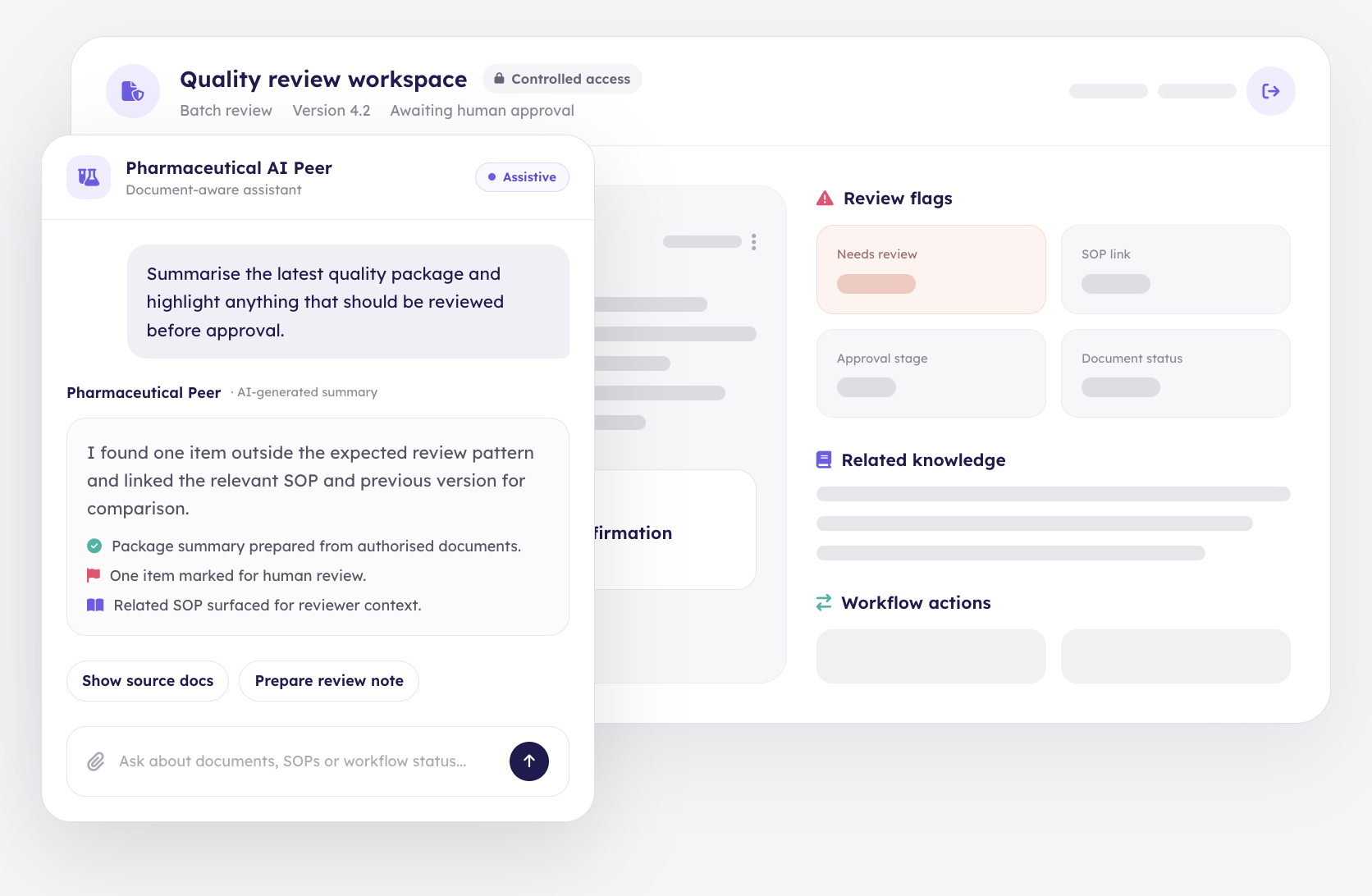
Quality review workspace
Controlled accessReview summary
Authorised package overview
Current step
Quality review
Next action
Reviewer confirmation required
Review flags
Needs review
SOP link
Approval stage
Document status
Related knowledge
Workflow actions
Pharmaceutical AI Peer
Document-aware assistant
Summarise the latest quality package and highlight anything that should be reviewed before approval.
I found one item outside the expected review pattern and linked the relevant SOP and previous version for comparison.
AI is more useful when regulated knowledge and workflow context are connected.
Bring together the documents, systems and internal knowledge behind regulated work so teams spend less time searching and more time reviewing and moving work forward.
Quality documents
Regulatory knowledge
Research content
SOPs & policies
Workflow history
Approvals & roles
Reduce friction across regulated, document-heavy work.
Pharmaceutical teams often work across long review cycles, dispersed knowledge and approval-heavy processes. AI should help organise and accelerate the work, not bypass the controls around it.
Scattered knowledge
Teams search across repositories, SOPs, regulatory content and previous documents before they can begin the actual review.
Document burden
Summarising, comparing and preparing review notes takes time across quality, regulatory and research-related workflows.
Approval bottlenecks
Work can stall when the right reviewer context, supporting documents and workflow status are not easy to surface.
Governance sensitivity
The workflow needs speed, but also clear access, traceability, human review and process discipline.
Build pharmaceutical AI around review, knowledge and governance.
Connect the right controlled sources and shape the peer around your internal review process, workflow boundaries and human approval model.
Discuss your workflowSearch controlled knowledge
Make SOPs, approved references, quality documents and internal knowledge easier to retrieve through a governed interface.
Summarise document packages
Prepare concise summaries of long, document-heavy workflows before the review and approval stages.
Support review workflows
Flag items for human review, surface source documents and support structured workflow coordination.
Connect approved actions
Move from information to routing, updates and next-step workflow actions within the right guardrails.
Build practical AI workflows across pharmaceutical operations.
Start with one review-heavy or knowledge-heavy workflow, then expand into adjacent pharmaceutical processes as your team gains confidence.
Quality document support
Search, summarise and prepare context around quality documents, reviews and related internal procedures.
SOP & policy Q&A
Make approved SOPs, policies and internal references easier to access through a conversational interface.
Regulatory content review
Prepare structured summaries and support review workflows for regulatory or submission-related content.
Research knowledge support
Bring together internal research notes, scientific content and related knowledge for faster information retrieval.
Deviation & review workflows
Support document-heavy investigation, review and follow-up workflows with connected context and human oversight.
Approval coordination
Prepare review notes, surface relevant references and help move work through defined internal approval paths.
Ask once. Bring the document and workflow context together.
A pharmaceutical AI peer can retrieve authorised documents, related SOPs and workflow history, then prepare an assistive summary for the next reviewer.
Pharmaceutical Peer
AI agent · Governed review context
What changed in the latest quality package compared with the previous approved version?
Connected sources checked
I found one change in the review section that should be checked against the current SOP. The latest package also includes an additional reviewer note that was not present in the previously approved version.
What should I review first?
Start with the flagged section and the linked SOP reference, then review the new note before moving the document to the next approval stage.
Connect AI to the systems and repositories your teams already use.
Fit AI into your controlled environment through the right knowledge sources, workflow systems, roles and deployment model.
Discuss your architectureDocument repositories
Connect the controlled document sources and knowledge repositories relevant to the target workflow.
QMS & workflow tools
Bring workflow status, task context and approval steps into the assistive experience where appropriate.
Research & knowledge sources
Connect internal scientific, operational and process knowledge required for the selected use case.
Governance & deployment
Shape access, model, deployment and workflow controls around your organisation’s operational and compliance requirements.
Start with one regulated workflow, then expand.
Begin with a review-heavy or document-heavy process where connected knowledge can reduce friction, then expand into adjacent workflows with the right governance.
01
Connect the knowledge
Bring together the documents, references and workflow data required for the selected pharmaceutical use case.
02
Define the peer
Shape it around source permissions, process boundaries, review requirements and the workflows your team actually uses.
03
Connect approved actions
Move from answers to structured workflow steps such as review notes, routing and next-step coordination.
Put AI to work on regulated pharmaceutical workflows.
Build AI peers that connect trusted documents, support review-heavy processes and help teams move faster without losing governance and human oversight.