

AI agent governance is the set of policies, controls, monitoring and oversight that keeps autonomous AI agents safe, predictable and aligned with business and regulatory requirements. For every agent, it answers three questions: what the agent is allowed to do and for whom, what it actually did and why, and what happens when it makes a mistake or needs a person to review its work.
Key takeaways
- Governance is day-to-day operating practice for agents that act in real systems: access control, traceability, human oversight, guardrails and monitoring.
- This guide organises the work into five pillars: policy and access control, model governance, data governance, execution and workflow control, and monitoring, observability and risk management.
- The EU AI Act applies its risk-based framework to AI agents. Obligations for high-risk deployments include a documented risk management system, data governance, transparency towards users, human oversight and post-market monitoring, and an agent that changes over time is not exempt from the obligations that applied at launch.
- In the UK, sector regulators such as the FCA and the ICO apply existing frameworks, so governance controls should map to the obligations a firm already has rather than replace them.
- Build governance in before the first prompt: define each agent’s scope, permissions, escalation logic and failure modes, start with low-risk workflows where mistakes can be put right, and review logs and incidents regularly.
You have deployed an AI agent. It has access to your CRM, your customer data and your internal knowledge base. It can draft emails, trigger workflows and escalate tickets without asking for permission every time. That autonomy is exactly why you built it.
Now ask yourself: do you know what it decided yesterday? Can you explain its reasoning to an auditor? Do you know which actions it took on behalf of which users?
If the answer is no, you are not alone. Deloitte’s 2026 State of AI in the Enterprise survey found that only 21% of companies planning to deploy agentic AI have a mature model for agent governance. And the consequences of that gap are beginning to show up in hard numbers.
Gartner predicts over 40% of agentic AI projects will be cancelled by the end of 2027 due to escalating costs, unclear business value or inadequate risk controls. (Gartner, June 2025)
This guide explains what AI agent governance is, why it matters right now and how enterprise teams can build it into their AI deployments from day one.
What Is AI Agent Governance?
AI agent governance is the combination of policies, controls, monitoring and oversight mechanisms that an organisation puts in place to ensure its AI agents behave safely, predictably and in line with business and regulatory requirements.
It covers three core questions:
- What is the agent allowed to do, and on whose behalf?
- What did the agent actually do, and why?
- What happens when the agent makes a mistake or reaches a decision that needs human review?
Governance is not the same as safety or alignment in the research sense. It is operational: the day-to-day mechanisms that keep AI agents accountable across your organisation as they scale from one department to fifty.
Why AI Agent Governance Matters Right Now
Three forces are converging to make governance the defining challenge of enterprise AI in 2026.
-
Adoption Is Moving Faster Than Controls
- 40% of enterprise applications will feature task-specific AI agents by the end of 2026, up from less than 5% in 2025. (Gartner, August 2025)
Organisations are deploying agents quickly, often without the infrastructure to monitor what those agents are doing. Governance frameworks get treated as a future concern. They are not.
-
The Legal and Regulatory Landscape Is Hardening
The EU AI Act became the world’s first comprehensive AI regulation, with rules on general-purpose AI models effective from August 2025. Agentic AI systems fall under its risk-based framework. High-risk deployments, including those used in employment, financial services and healthcare, carry requirements for risk management systems, data governance, human oversight and full auditability.
- By 2030, fragmented AI regulation will quadruple and extend to 75% of the world’s economies, driving $1 billion in total compliance spend. (Gartner, February 2026)
The UK is developing its own regulatory approach through the AI Security Institute (formerly the AI Safety Institute) and sector-specific guidance from the FCA and ICO. Whether you operate under the EU AI Act, UK frameworks or both, governance is no longer optional.
-
The Cost of Getting It Wrong Is Climbing
- Gartner predicts that by the end of 2026, “death by AI” legal claims will exceed 2,000 due to insufficient AI risk guardrails. (Gartner, October 2025)
An agent that sends the wrong message to the wrong customer, executes a transaction without authorisation or leaks sensitive data through a poorly scoped tool call creates liability that is hard to contain. And unlike a bug in a static application, the decision trace of an AI agent is much harder to reconstruct after the fact without the right infrastructure.
AI Agent Governance Framework: The 5 Core Pillars
A practical AI agent governance framework consists of 5 core pillars that define how AI agents are controlled, monitored and scaled across the enterprise. Together, these pillars ensure that agentic AI systems operate reliably, securely and in alignment with business objectives.
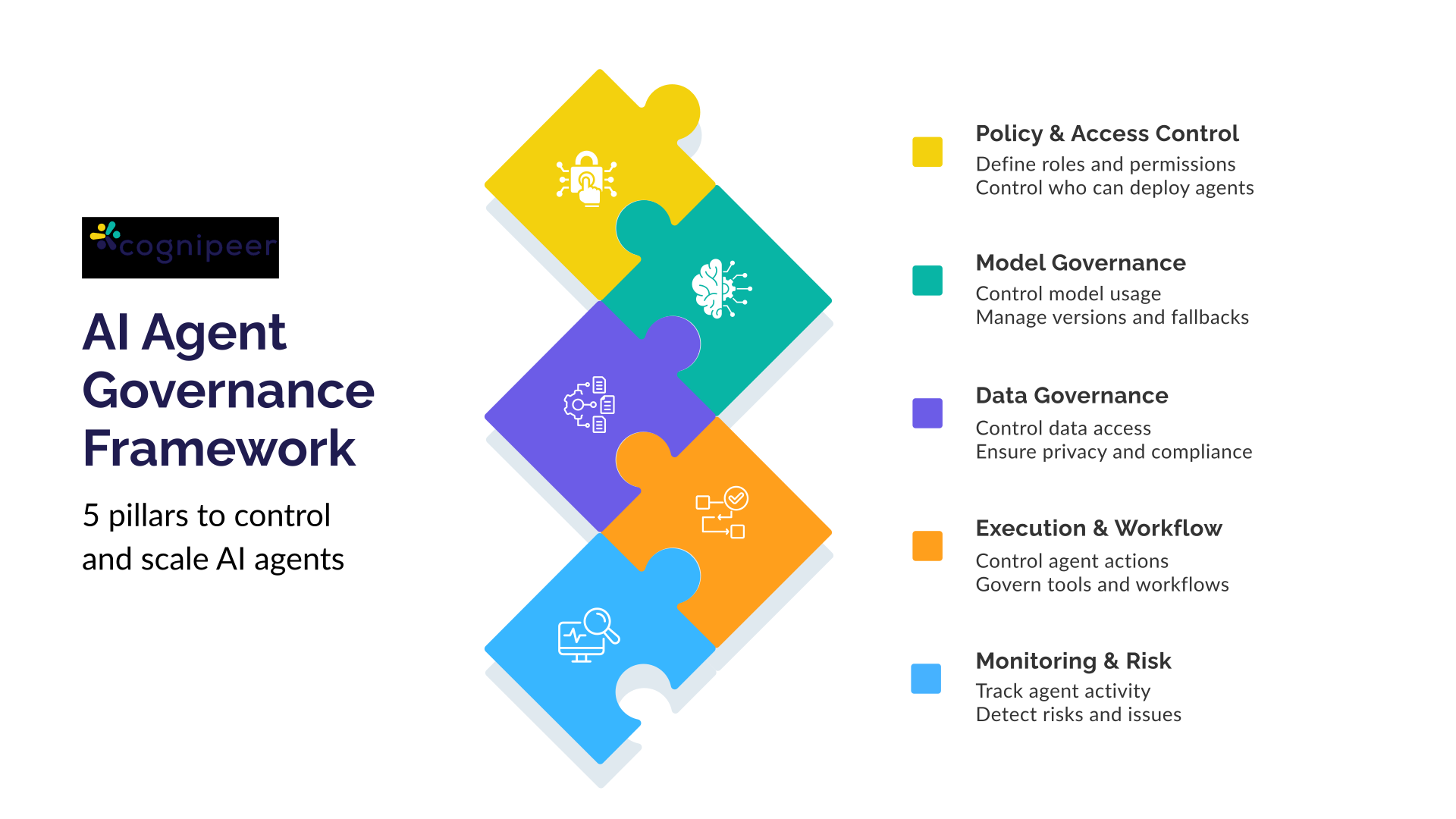
1. Policy & Access Control
This pillar defines who can create, modify and operate AI agents, and under what conditions.
It includes role-based access control, approval workflows and policy enforcement mechanisms that ensure agents are deployed within clearly defined boundaries. Without this layer, organisations risk uncontrolled agent proliferation and inconsistent usage across teams.
2. Model Governance
Model governance ensures that the right models are used for the right tasks, with full control over performance, cost and risk.
This includes model selection, versioning, fallback strategies and usage policies. It also ensures that changes to underlying models do not introduce unexpected behaviour in production environments.
3. Data Governance
AI agents rely heavily on data, making governance at this level critical.
This pillar defines what data agents can access, how it is used and how it is protected. It covers data privacy, security controls, access permissions and retention policies, ensuring compliance with internal standards and external regulations.
4. Execution & Workflow Control
Unlike traditional AI systems, agents take actions.
This pillar governs how agents interact with tools, systems and workflows, including API calls, task execution and multi-step processes. It ensures that agent actions are predictable, controlled and aligned with defined business logic.
In practice, the agent can prepare the work while people keep the decision. In our internal audit readiness project for a bank, process owners were responsible for closing each gap and the internal audit team kept ownership of the audit.
5. Monitoring, Observability & Risk Management
This pillar ensures that every agent action is visible, traceable and measurable.
It includes logging, tracing, performance monitoring and audit trails, as well as mechanisms to detect anomalies, manage risk and enforce compliance. This is what enables organisations to move from experimentation to enterprise-grade reliability.
- Organisations that deployed AI governance platforms are 3.4 times more likely to achieve high effectiveness in AI governance than those that do not, according to a Gartner survey of 360 organisations in the second quarter of 2025. (Gartner, February 2026)
AI Agent Governance and the Regulatory Landscape
EU AI Act
The EU AI Act applies to agentic AI systems under a risk-based framework. Key obligations for high-risk deployments include: a documented risk management system maintained throughout the system lifecycle, technical robustness and accuracy requirements, data governance controls, transparency obligations towards users, human oversight measures and post-market monitoring.
Because agentic systems can self-update, the AI Act requires continuous monitoring and change control. An agent that evolves its behaviour over time is not exempt from the obligations that applied at launch.
UK Regulatory Context
The UK has taken a principles-based approach to AI regulation, with sector regulators including the FCA, ICO and CMA applying existing frameworks to AI deployments. The FCA applies its existing rules to AI, and those rules ‘emphasise accountability for senior managers’. Human oversight and explainability are consistent expectations across sectors.
For UK enterprises, this means governance frameworks need to map to your existing regulatory obligations, not replace them.
How to Implement AI Agent Governance in Practice
Governance does not have to mean slowing down. The organisations that implement it well treat it as part of the build process, not an audit exercise after the fact. Here is a practical sequence to follow.
Start with a governance-by-design approach
Define the agent’s scope, permissions and escalation logic before you write the first prompt. Know which systems it will touch, which users it will act on behalf of, and what the failure modes look like. Document this as you would document any other system specification.
Choose a platform that makes governance native
Governance is significantly harder to retrofit than to build in. Look for platforms that provide role-based permissions at the agent level, structured logging of all agent actions, configurable guardrails at the infrastructure layer and built-in HITL workflow support.
cognipeer’s platform is designed around this principle. The Console layer provides model routing, guardrail policies, per-project quotas, tracing and audit logs, and can be configured to support your audit and policy requirements. Agent executions, tool calls and LLM requests are traced at the platform level, without needing to instrument the model itself.
Implement incrementally
Start with agents that operate in low-risk, high-visibility workflows. Build your monitoring and escalation processes there, where mistakes are recoverable and learnings are cheap. Expand to higher-stakes workflows once your governance infrastructure has proven itself.
Map governance controls to regulatory obligations
If you operate in financial services, healthcare or any other regulated sector, map each governance control to the specific obligation it satisfies. This makes compliance reviews significantly more efficient and demonstrates to regulators that governance is intentional, not incidental.
AI can also help teams keep track of changes to those obligations. See how a bank used AI for pre-assessment of regulatory changes, with its experts owning the assessment.
Review and iterate
Set a regular cadence for reviewing agent performance data, escalation logs and any incidents. Use this data to tighten guardrails, update permissions and refine escalation logic. Governance is a living process.
What Good AI Agent Governance Looks Like in 2026
The enterprises that are scaling agentic AI successfully in 2026 share a common characteristic: they treat governance as an enabler, not a constraint. Governance is what allows them to give agents real autonomy over real workflows, because they have the controls in place to catch problems early and the audit trail to understand what happened.
- McKinsey estimates that generative AI could add the equivalent of $2.6 trillion to $4.4 trillion annually across the 63 use cases it analysed. (McKinsey, June 2023)
That value is only accessible to organisations that can deploy agents with confidence. And confidence comes from governance.
The organisations that skip governance to move faster will not catch up. They will spend the next twelve months unwinding deployments that went wrong, managing incidents that were predictable, and rebuilding trust they did not have to lose.
Frequently Asked Questions
What is AI agent governance?
AI agent governance is the set of policies, controls and oversight mechanisms that organisations use to ensure autonomous AI agents behave safely, predictably and in compliance with internal and regulatory requirements. It covers permissions and access control, traceability, human oversight, guardrails and continuous monitoring.
Why is AI agent governance important for enterprises?
Without governance, AI agents can make autonomous decisions that expose your organisation to legal, financial and reputational risk. Gartner predicts over 40% of agentic AI projects will be cancelled by the end of 2027 due to escalating costs, unclear business value or inadequate risk controls. Governance is what separates pilots that scale from pilots that get cancelled.
What are the key pillars of AI agent governance?
The five pillars are policy and access control (who can create, modify and operate AI agents, and under what conditions), model governance (the right models for the right tasks, with control over performance, cost and risk), data governance (control over the data agents rely on), execution and workflow control (the actions agents take) and monitoring, observability and risk management (making every agent action visible, traceable and measurable).
Does the EU AI Act apply to AI agents?
Yes. The EU AI Act applies to agentic AI systems under its technology-neutral, risk-based framework. High-risk deployments require documented risk management, human oversight, data governance and full auditability. General-purpose AI model obligations became effective in August 2025. Because agentic systems can self-update, continuous monitoring and change control are explicit requirements.
Next Steps
If you are building or scaling AI agents inside your enterprise, cognipeer provides the governance infrastructure to do it with confidence: role-based permissions, guardrail policies, tracing and audit logs, and human-in-the-loop workflow support, built into a single platform.
See how this would work in your organisation.
Read anonymised customer projects, from regulatory change pre-assessment at a bank to request routing in the public sector, or talk to our team about your own use cases.